
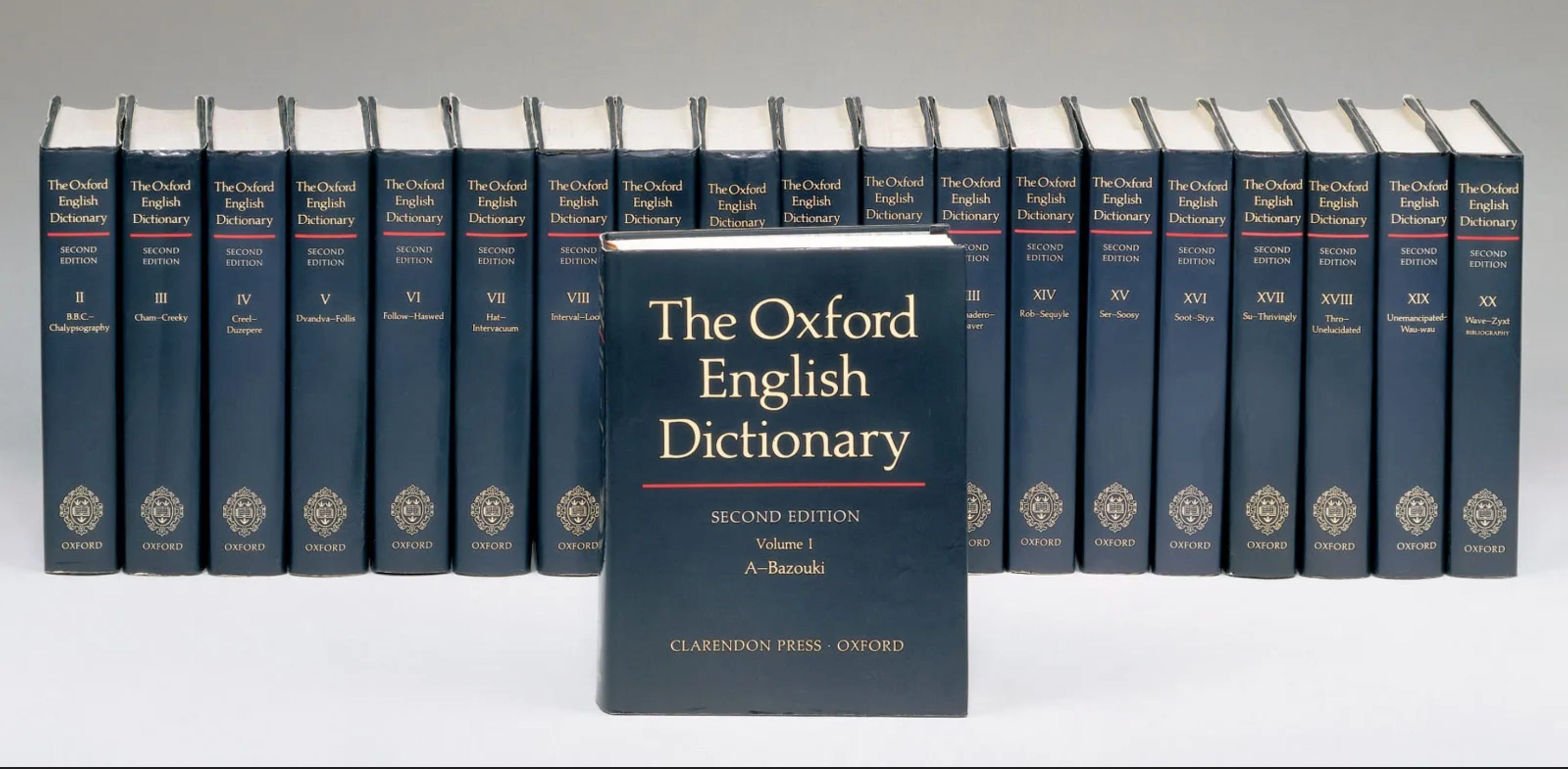
The twenty volumes were in excellent condition, their navy-blue bindings marked only by Dewey decimal labels. The pages, as far as I could tell, had escaped both the ordinary indignities of school use and the more honorable injuries of sustained reading. They were the 1989 second edition of the Oxford English Dictionary: twenty volumes, 21,728 pages, and several shelves’ and more than a century’s worth of scholarly ambition on a scale that is hard to imagine.
Since 2019, I have been writing about the history of the English language, consulting the OED online as a primary reference. I have the two-volume set with the magnifying glass, which is an amusing artifact, but I have never seen the complete 20-volume set anywhere.
The school library was going to throw them away.
It is easy enough to understand the decision. No sensible librarian wishes to make a principle of retaining every displaced reference work, and the old OED, the final edition that will ever be printed, has certainly been displaced. The online dictionary is more current, more readily searchable, more capacious, and thus more useful for any conceivable act of scholarship. A student who needs to know the earliest recorded English use of a word, the date of a particular sense, or the etymological route by which a foreign term entered English should no longer be required to lift a volume the weight of a bowling ball before receiving an answer.
While not contemporary, the second edition is also no untouched survivor from the Victorian age. Published in 1989, it amalgamated the original OED with the accumulated supplementary volumes and added 5,000 new entries. It was a monument already built partly out of a series of revisions: a record of the language continually amended by further reading. Still, the sight of those volumes stacked on the library floor and awaiting the dumpster (crowned ignominiously with a sticky note that said, in all capital letters, THROW AWAY) seemed even to me less like an occasion for lamentation than a clear example of social and historical fact. Here was a great physical “machine” for reading, perfectly preserved, becoming surplus because the practices for which it had been made have changed dramatically and in short order.
Reader, I brought it home.
The dictionary is still in search of a shelf, presently and temporarily stacked against an already-full shelf, taller than my children. I have already started reading it. Not that I will consult it in place of its electronic successor. I will not. When I want to know something efficiently, I use the electronic OED, like everyone else. Who can afford the privilege of Luddism? But the printed set has made possible a kind of reading that the search box is designed to prevent: reading not for a term but among terms.
A digital dictionary gives the reader exactly what the reader asks for. This is its great, perhaps its only, virtue. Type meshuggener, serendipity, rebarbative, or floccinaucinihilipilification, and the desired word appears, accompanied by pronunciation, etymology, definition, historical senses, quotations, and links to related forms. The entry is discrete. It has been extracted from the alphabetical mass and placed before the user as a solution to a problem.
The printed dictionary does not refuse this transaction, exactly, but certainly it complicates it. One must locate the correct volume, take it down, find the approximate alphabetical neighborhood, and turn pages. The desired word arrives amid a cacophony of others: obsolete spellings, compounds no one now uses, botanical names, technical verbs, dialect forms, remnants of once ordinary social distinctions. Not to mention entirely different words that invariably catch the eye. The reader of the physical book finds not merely a word but an environment.
The OED has never really been just a list of definitions. Its characteristic method is citational, a feature as distinct in the nineteenth century as it is today. An entry establishes its senses through a sequence of dated quotations, which make the word’s history visible not as an abstract account of linguistic change but as a series of particular acts of use. A word appears in a sermon, a legal document, a newspaper, a treatise on chemistry, a novel, a letter, a joke. Its history is assembled from evidence, but the evidence is literary and social as well as lexical. The dictionary records not only what English contains but the textual circumstances through which certain Englishes became recorded (or recordable) in the first place. (Currently I am compiling a manuscript on “Yiddish” Englishes and their origins in the OED, so more to come on this score.)
That is one reason a physical OED rewards idle perusal. Its pages contain an extraordinary number of little narratives of admission. Here is a word that has entered English from a trade; here another made familiar by a novelist; here a term borrowed from a language that English speakers first encountered in scripture, colonial administration, scientific classification, immigration, or domestic life. The familiar image of the dictionary as a neutral authority is not wholly wrong, but it conceals the history of selection behind it. A dictionary’s quotations are evidence; they are also decisions about what evidence was available, credible, and worth preserving.
The printed volumes make that process harder to overlook. Their immense bulk gives form to a simple fact that English is not contained in any single reader’s vocabulary, nor even in the ordinary corpus of literature that readers conventionally call English. It is instead an aggregate of specialized practices and linguistic encounters. The dictionary’s alphabetical order treats these materials with a strange equanimity. A theological term may sit beside a word from the stable, a schoolroom slang term beside a medieval legal form, a Hebrew-derived ritual word beside an industrial neologism. They are not equal in history or consequence, but they do share a page.
Enter serendipity. The word has been worn smooth by recommendation engines, discovery tools, and the promise that a machine can know what one will enjoy before one has encountered it. But serendipity in the printed dictionary is not the artificial surprise of a system offering adjacent “content” (to borrow a loathsome usage). It is the consequence of slowness and contingency. One begins with a question, encounters an obstacle in the form of a large book and thin pages, and notices something that would otherwise have remained wholly outside the scope of inquiry.
The discovery may very well be trivial; certainly it will be incidental, a word formerly used for an object long vanished, a citation from an author one had not expected to find in the dictionary, a definition whose earlier sense makes a familiar line newly strange. But triviality is not the opposite of learning. Such discoveries accumulate. They train the reader to recognize that words have neighbors, that meanings have predecessors, and that language is not merely a transparent medium for conveying the information one already knows to seek.
This is not an argument against weeding, or digitization, or the hard decisions libraries make under conditions of limited space and money. A library cannot be a mausoleum for every obsolete format, and the case for digital access is especially strong where it allows more people to use a resource more fully. The old OED is not more authoritative because it is heavy, and it is certainly not more democratic because it is difficult to move.
But its uselessness had been overstated. The set had ceased to be efficient as a public reference tool; it had not ceased to be intellectually alive. In its new home, it has become an object for a different kind of consultation: not the swift recovery of a fact, but a practice of attention in which a fact may become an occasion for further reading.
The navy-blue volumes were spared not because they represent a better age of scholarship, nor because books are sacred merely by being books. The former is debatable, the latter certainly is not. They were spared because the OED remains what it has always been: a record of English made from the compiled ephemera of people using it. To browse it is to discover that the language does not lie dormant under its headwords. It moves sideways, through quotation and association, carrying the reader toward words and thoughts and associations that no electronic search could have ever begun to supply.